


Page 32 - November-December Together
P. 32
TOGETHER NOVEMBER – DECEMBER 2021


     The Big Review  THE BIG REVIEW


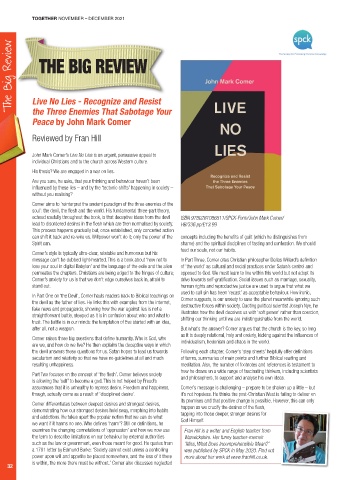
            Live No Lies - Recognize and Resist
            the Three Enemies That Sabotage Your

            Peace by John Mark Comer

            Reviewed by Fran Hill


            John Mark Comer’s Live No Lies is an urgent, persuasive appeal to
            individual Christians and to the church across Western culture.
            His thesis? We are engaged in a war on lies.
            Are you sure, he asks, that your thinking and behaviour haven’t been
            influenced by these lies – and by the ‘tectonic shifts’ happening in society –
            without you realising?
            Comer aims to ‘reinterpret the ancient paradigm of the three enemies of the
            soul’: the devil, the flesh and the world. His fundamental three-part theory,
            echoed usefully throughout the book, is that deceptive ideas from the devil   ISBN 9780281086511/SPCK-Form/John Mark Comer/
            lead to disordered desires in the flesh which are then normalised by society.   HB/336 pp/£13.99
            This process happens gradually but, once established, only concerted action
            can shift it back and re-wire us. Willpower won’t do it; only the power of the   concepts including the benefits of guilt (which he distinguishes from
            Spirit can.                                         shame) and the spiritual disciplines of fasting and confession. We should
                                                                feed our souls, not our habits.
            Comer’s style is typically ultra-clear, relatable and humorous but his
            message can’t be dubbed light-hearted. This is a book about ‘how not to   In Part Three, Comer cites Christian philosopher Dallas Willard’s definition
            lose your soul in digital Babylon’ and the language of the exile and the alien   of ‘the world’ as cultural and social practices under Satan’s control and
            permeates the chapters. Christians are being edged to the fringes of culture;  opposed to God. We must learn to live within this world but not adopt its
            Comer’s anxiety for us is that we don’t edge ourselves back in, afraid to   drive towards self-gratification. Social issues such as marriage, sexuality,
            stand out.                                          human rights and reproductive justice are used to argue that what we
                                                                used to call sin has been ‘recast’ as acceptable behaviour. How ironic,
            In Part One on ‘the Devil’, Comer hauls readers back to Biblical teachings on
            the devil as the father of lies. He links this with examples from the internet,   Comer suggests, is our anxiety to save the planet meanwhile ignoring such
                                                                destructive forces within society. Quoting political scientist Joseph Nye, he
            fake news and propaganda, showing how the war against lies is not a
            straightforward battle, steeped as it is in confusion about who and what to   illustrates how the devil deceives us with ‘soft power’ rather than coercion,
                                                                shifting our thinking until we are indistinguishable from the world.
            trust. The battle is in our minds: the temptation of Eve started with an idea,
            after all, not a weapon.                            But what’s the answer? Comer argues that the church is the key, so long
                                                                as it is deeply relational, holy and orderly, kicking against the influences of
            Comer raises three big questions that define humanity. Who is God, who
            are we, and how do we live? He then explains the deceptive ways in which   individualism, hedonism and chaos in the world.
            the devil answers these questions for us. Satan hopes to lead us towards   Following each chapter, Comer’s ‘step sheets’ helpfully offer definitions
            secularism and relativity so that we have no guidelines at all and much   of terms, summaries of main points and further Biblical reading and
            resulting unhappiness.                              meditation. Also, the number of footnotes and references is testament to
                                                                how he draws on a wide range of fascinating thinkers, including scientists
            Part Two focuses on the concept of ‘the flesh’. Comer believes society
            is allowing the ‘self’ to become a god. This is not helped by Freud’s   and philosophers, to support and analyse his own ideas.
            assurances that it is unhealthy to repress desire. Freedom and happiness,   Comer’s message is challenging – prepare to be shaken up a little – but
            though, actually come as a result of ‘disciplined desire’.   it’s not hopeless. He thinks the post-Christian West is failing to deliver on
                                                                its promises and that positive change is possible. However, this can only
            Comer differentiates between deepest desires and strongest desires,   happen as we crucify the desires of the flesh,
            demonstrating how our strongest desires hold sway, morphing into habits
            and addictions. He takes apart the popular notion that we can do what   tapping into those deeper, stronger desires for
                                                                God Himself.
            we want if it harms no one. Who defines ‘harm’? Still on definitions, he
            examines the changing connotations of ‘oppression’ and how we now use   Fran Hill is a writer and English teacher from
            the term to describe limitations on our behaviour by external authorities   Warwickshire. Her funny teacher-memoir
            such as the law or government, even those meant for good. He quotes from   ‘Miss, What Does Incomprehensible Mean?’
            a 1791 letter by Edmund Burke: ‘Society cannot exist unless a controlling   was published by SPCK in May 2020. Find out
            power upon will and appetite be placed somewhere, and the less of it there   more about her work at www.franhill.co.uk.
            is within, the more there must be without.’ Comer also discusses neglected
    32

